

A few years ago, I fell down the stairs.
I know you might feel mislead reading this, considering the title of this post, but stay with me.
I actually somehow managed to achieve this fall while going up the stairs. One minute I was heading up the stairs, and the next moment I waking up at the bottom.
I had been in my room, on the bottom floor of my mum’s house, and suddenly felt a strange sense of impending doom. Something was not right. And then, my terrible survival skills told me that in this situation I need to climb stairs, to tell my mum that I wasn’t feeling well.
Then—a blank space.
A blank space that was filled with a moment of peace.
There was a moment in between waking up, where I remember being pretty certain I was on a beach. I think my ears were ringing a lot, and this manifested into the sound of waves. Of course I was on a beach, lying next to the water, that made complete sense to me. Like a dream where you have no concept of how you had arrived: just the certainty —I’m here now, at the sea.
A moment of serenity before I woke up, very confused, very teary, and realised I had absolutely terrified my step-dad who had found me, and there was no beach.
Thankfully I was okay.
I went through a lot after this, but I’m ok.
I didn’t intend to actually write about the fall and my experience after, but I did want to give some context for where this post is going: what my anxiety journal taught me.
After the fall, I became deeply afraid it would happen again.
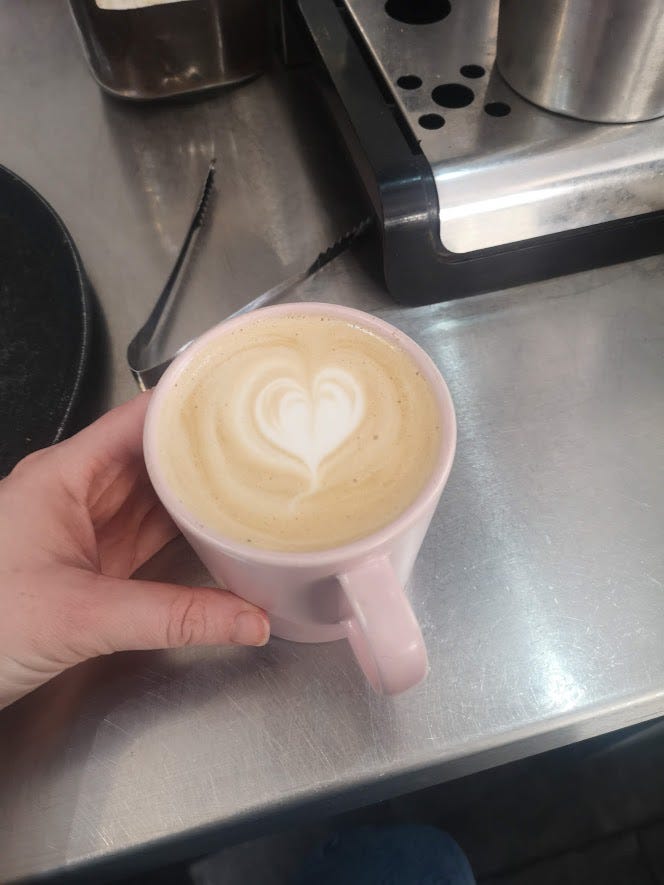
I was working in a coffee shop. I loved being a barista—my colleagues were lovely and it was a very much needed safe haven at the time. But I started feeling less and less in my body. You want this body to move, to take steps, to lift cups. Put those cups on a tray. Carry the tray to table 7. Without spilling it on the lady??
I was certain I would faint, every day.
I never did.
But all my energy went into distracting myself or calming myself down.
I’d think: just make it five more minutes. Just get to 2pm. At the end of the day, I always felt better—knowing I could return to my bed and rest. But during the day, every task felt paralyzed by anxiety.
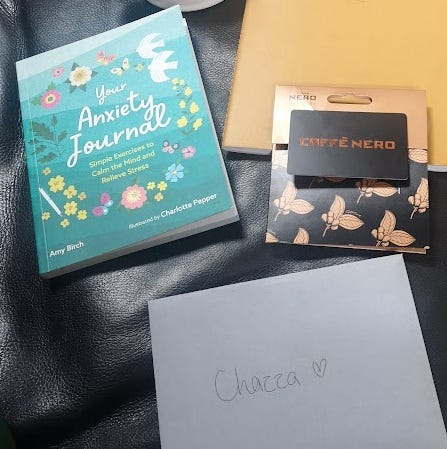
For my birthday that year, my friend bought me this anxiety journal.
One prompt asked me to describe a scary moment of the day and what helped. I wrote about one of those days at work. In the “What helped?” column, I wrote:
“Laughing.”
I remembered talking to my colleagues. Someone told a joke. We laughed.
Laughter is such a powerful force. Anxious thoughts can feel just as powerful. With enough of them, they can spiral into something monstrous—a dragon made of fear and noise. And laughter is the only thing that can slay it.
If you read my post about my recent health issues you may be confused about the overlap. The pattern is:
Actual health issue → anxious thoughts → become detached from body → anxious thoughts about those symptoms → even more symptoms.
It’s a spiral. A loop. A mess of different issues over the years.
Some problems are unresolved—maybe they’ll never be resolved. But some symptoms I can notice, laugh at, and watch evaporate.
Why does laughter help?
Laughter doesn’t fix everything. But it opens a window. It shows us in our view that there is “something else.”
It doesn’t deny the dragon. It just reminds me that dragons can be silly! That even in the middle of fear, there’s room for fun.
I’ve often found myself very stuck in these loops thinking: this is the only feeling. This is the only thought. No hope is possible.
Laughter reminds us that there is.
To recap:
I fell down the stairs, but I’m okay.
I’ve had other long-standing symptoms that I’m now paying attention to.
Many of those symptoms are caused by worrying about the symptoms.
I’m grateful that I’m both accepting the situation and caring about the situation.
I accept that this is how I feel. That these symptoms may never go away. That maybe they’re just…mine.
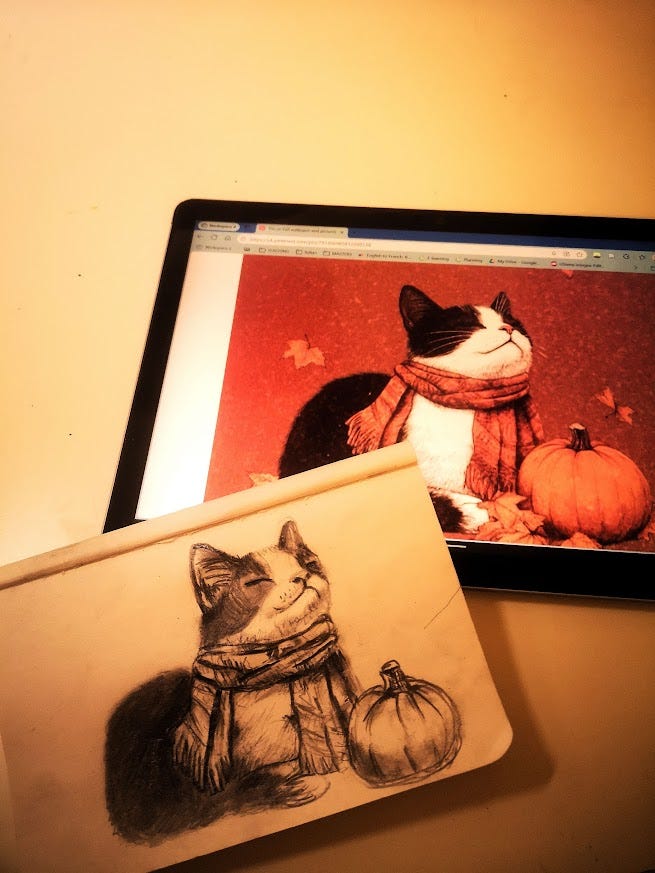
And I’m caring enough to get help. See doctors. Work on my diet. Take care of myself. Focus on creativity—on what feels like me.
I started writing to heal from a relationship ending. From things outside of me.
Then I came back to myself—and found my inner home in such a messy state. I’d built a life around avoiding the one I was actually living in. I didn’t want to face my symptoms, or the reality of how I felt.
The reality is lately, I feel really happy!
Life is more manageable. Things that felt stressful don’t feel like as heavy. I work on little things that make me happy every day, that might turn into bigger goals, but I respect whatever I do in a day. If I need to rest, that’s ok.
But then…
The Final Test
It’s very normal for students to feel anxious before taking a final test. But often, the anxiety is not from a lack of knowledge—but because passing the test means something else. It means you’re ready. Here’s a new responsibility. It means someone might say, “You can do this now.” And that’s terrifying.
Passing the test means stepping into the next thing. It means being expected to know, to continue, to show up. And sometimes, we’re not ready. Sometimes, we are ready—and still don’t feel ready. And that’s okay.
I feel like I’m on that horizon. Ready to live my life again. Noticing how I wasn’t living it. And it’s really scary.
If I wasn’t dizzy—who would I be?
Am I ready to step into a life I’ve been afraid to live?
Returning to your body after something like that is hard. The body can feel so far away from the mind, like you’re trying to control it with a remote. And the loops you describe are so common for the ruminating mind and can be so tough to break. I feel like those loops are a fractal of the bigger cycles of life. Similar problems and situations arise in cycles over the years and each time you hopefully handle it better because you’ve learned from the last cycle. In the same way, you handle anxiety cycles better the more you learn how to deal with it. Love that you found help through laughter! That’s my favorite coping mechanism - it changes your perspective on what’s happening and, like you said, reminds you even dragons can be silly
sometimes I think the constant anxiety is so much more terrifying than the actual illness, and all the time spent overthinking and afraid that the symptoms are going to recur, and in the most terrible circumstances 😭 I love the way you capture that so, so perfectly, Charlotte 🥺 I loved this so much.